
AI agent discovery · Field note
What Is an AI Agent? How Developers Are Creating Shadow Agents?
Learn what an AI agent is, how developer workflows become shadow agents, why they escape enterprise inventories, and how edge-first discovery restores visibility.
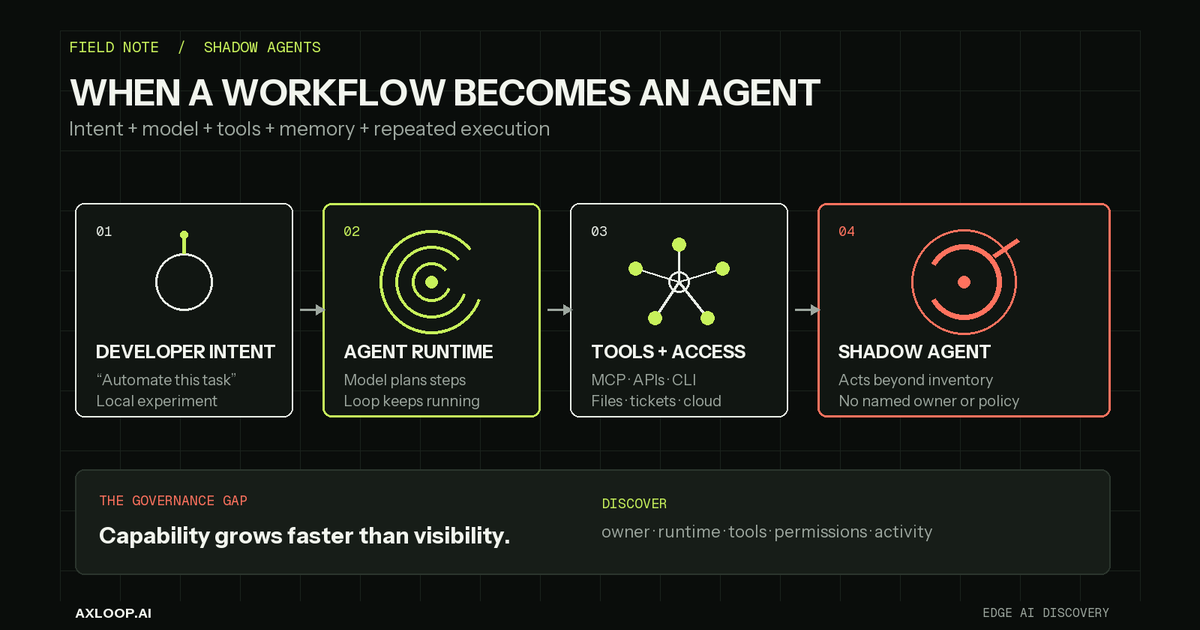
An AI agent is a software system that uses an AI model to interpret a goal, choose or plan steps, use tools and data, and take actions with some degree of autonomy. A shadow agent is that same kind of system operating outside an organization’s complete inventory, ownership, security review, or governance process.
Developers are creating shadow agents whenever a useful experiment quietly becomes a repeatable workflow with access to code, files, credentials, APIs, cloud services, or business systems. The agent may begin as a local script or coding-assistant extension. Once it can reason, call tools, retain context, and act repeatedly, it has become an operational system—even if nobody formally deployed it.
What is an AI agent?
An AI agent combines a model with instructions, context, memory, tools, and an execution loop. Unlike a basic chatbot that responds to one message, an agent can decide what to do next, invoke a function, inspect the result, revise its plan, and continue until it reaches a goal or a stopping condition.
A practical AI agent usually contains five elements: a goal or instruction; an AI model that interprets the task; context or memory; tools that read data or change systems; and a runtime that coordinates repeated steps. The exact design varies, but agency begins when software can select and execute actions rather than only generate text for a person to copy.
- Goal: the outcome the agent is expected to pursue.
- Model: the reasoning or decision engine used to select the next step.
- Context and memory: information about the user, task, prior steps, or environment.
- Tools: MCP servers, APIs, command-line programs, browsers, databases, or other capabilities.
- Runtime: the loop that sends requests, receives results, handles errors, and continues execution.
AI assistant, automation, and agent: what is the difference?
An AI assistant primarily helps a person produce or understand information. Traditional automation follows predefined rules. An AI agent can choose among available actions based on a goal and the state it observes. These categories overlap: an assistant can become agentic when it gains tools and an execution loop, while an agent can still require human approval for high-impact actions.
The useful question is not whether a product uses the word agent. Ask what the system can observe, which decisions it can make, which tools it can call, what it can change, and how long it can operate without another human instruction.
What is a shadow agent?
A shadow agent is an AI agent that is missing from the organization’s authoritative inventory or operates without clearly assigned ownership, approved access, appropriate review, or observable activity. It is the agentic form of shadow AI: useful capability adopted or assembled outside established visibility and control.
Shadow does not automatically mean malicious. Many shadow agents begin with legitimate developer intent: reducing repetitive work, testing a framework, triaging issues, generating code, or connecting an assistant to internal documentation. The governance gap appears when capability grows faster than visibility.
How developers are creating shadow agents
Modern development environments make agents easy to assemble. A developer can install an AI-enabled editor, download an agent framework, run a local model, connect an MCP server, or give a script an API token. Each choice may look like a small experiment. Together, they create a system that can act across multiple resources.
1. Turning coding assistants into autonomous workflows
A coding assistant becomes more agentic when it can inspect a repository, edit files, run tests, execute terminal commands, and retry after failures. If the workflow runs with local developer permissions but is not inventoried as an agent, it can become a shadow agent even though the original tool is approved.
2. Connecting tools through MCP
The Model Context Protocol, or MCP, standardizes how AI applications connect to tools, data sources, and workflows. That makes integration faster, but it also means a local configuration can grant an agent access to files, source control, tickets, databases, browsers, or cloud operations. An unregistered MCP configuration can change an assistant’s effective capability without changing the application name visible to central software inventory.
3. Building scripts around model APIs
A short script can call a model, parse its response, invoke an API, and repeat. Add a scheduler, webhook, queue, or continuous loop and the experiment becomes persistent automation. These agents may run on laptops, build servers, notebooks, virtual machines, or small internal services that traditional AI inventories do not recognize.
4. Running local models and open-source frameworks
Local models and open-source agent frameworks let developers test privately and move quickly. They may also bypass a central model gateway, leaving no server-side record of the model request. The activity still exists at the endpoint, along with local configuration, tool definitions, process evidence, and downstream actions.
5. Reusing personal or inherited credentials
Agents commonly inherit the access of the person or machine running them. A workflow may use a developer’s existing shell session, browser session, cloud credentials, source-control token, or service account. The agent’s practical reach can therefore be much broader than the model call suggests.
Why shadow agents are difficult to see
Most enterprise controls observe only one layer. Software inventory can identify an installed application but not every agent configured inside it. A model gateway can see requests routed through that gateway but not local models or direct provider access. Cloud logs see downstream API calls but may not preserve the initiating agent, user, prompt, tool definition, or local context.
The evidence is fragmented across endpoints, model providers, MCP clients and servers, APIs, identity systems, and business applications. Without correlation, an organization may know that a token accessed a system but not that a locally assembled agent initiated the action as part of a multi-step goal.
What risks do shadow agents create?
The primary risk is not the label shadow. It is an unknown combination of autonomy, access, data, and accountability. A low-permission local summarizer is different from a persistent agent that can modify production infrastructure. Risk assessment should follow the actual capability and evidence.
- Data exposure: prompts, retrieved context, or tool results can contain source code, credentials, customer records, or regulated information.
- Excessive permissions: the agent may inherit broad user or machine access instead of task-specific authorization.
- Unreviewed actions: generated commands, code changes, tickets, messages, or infrastructure operations may execute without suitable approval.
- Operational drift: models, prompts, tools, and MCP configurations can change without a central record.
- Unattributed cost: direct model calls and repeated loops can make spending difficult to assign to an owner or outcome.
- Weak accountability: incident responders may be unable to reconstruct which agent acted, why it acted, and what evidence it used.
How to discover shadow agents without blocking developers
A practical program starts with visibility rather than a blanket ban. Developers need room to experiment, while security and platform teams need evidence about capabilities that reach company systems. The shared objective is to make useful agents observable, owned, and appropriately bounded.
Discovery should begin where the agent actually runs. Endpoint evidence can reveal supported AI applications, local runtimes, known MCP configuration, tool declarations, and changes over time. Runtime telemetry can then connect agent activity to identity, model requests, tool calls, downstream systems, approvals, cost, and outcomes.
- Inventory agent-capable applications, local runtimes, scripts, and services.
- Discover MCP clients, servers, tool definitions, and configuration paths.
- Map effective permissions and credentials to the tools and data an agent can reach.
- Assign an owner, purpose, environment, and review status to each material workflow.
- Observe agent and tool activity with data minimization and redaction at the edge.
- Require approval for actions whose impact exceeds a defined threshold.
- Measure reliability, cost, policy exceptions, and business outcomes over time.
A useful shadow-agent inventory
An inventory entry should answer more than which product is installed. It should identify the agent or workflow, owner, runtime, model path, MCP servers, tools, data sources, permissions, execution pattern, and current governance status. It should also distinguish observed facts from inferred relationships and unsupported coverage.
That evidence helps teams prioritize. An unknown local experiment with no external access may need registration. An unattended agent with write access to production may need immediate containment and review. Treating both as identical produces noise and encourages developers to route around the process.
From shadow agent to governed agent
The goal is not to eliminate bottom-up innovation. It is to turn valuable experiments into accountable systems. A lightweight path can register an owner and purpose, document tools and data, narrow permissions, add telemetry, define approval points, test failure behavior, and establish a review date.
Governance should follow impact. Read-only research may need basic ownership and data controls. Agents that send messages, merge code, change infrastructure, move money, or update customer records need stronger identity, authorization, approval, audit, and rollback mechanisms.
The key takeaway
Developers are not creating shadow agents because they want invisible systems. They are combining accessible models, tools, protocols, and credentials faster than enterprise inventory can keep up. The answer is an edge-first discovery and observability layer that shows what exists, what each agent can reach, who owns it, and what it actually does.
Once that evidence exists, security, platform, and development teams can govern the highest-impact capabilities without stopping useful experimentation. Visibility turns shadow agents from an unknown attack surface into an operational fleet that can be reviewed, improved, and trusted.
Frequently asked questions
What is an AI agent?
An AI agent is software that uses an AI model to interpret a goal, plan or select steps, use tools or data, and take actions with some degree of autonomy.
What is a shadow agent?
A shadow agent is an AI agent operating outside an organization’s complete inventory, ownership, security review, or governance process.
How do developers create shadow agents?
Developers can create them by connecting coding assistants, scripts, agent frameworks, or local models to MCP servers, APIs, command-line tools, files, and credentials without registering the resulting workflow.
Is every developer-built agent a security risk?
No. Risk comes from missing visibility, unclear ownership, excessive permissions, sensitive data access, or unreviewed actions—not from developer experimentation itself.
How can enterprises discover shadow agents?
Enterprises need edge-first inventory that identifies agent runtimes, MCP configurations, tools, permissions, owners, and activity where developers actually work, then correlates that evidence centrally.